
The India-US strategic partnership is characterised by mutual trust and both sides are increasingly in agreement on key issues, such as countering China's aggression, promoting a free and open Indo-Pacific and addressing regional security challenges, Defence Minister Rajnath Singh said on Friday.
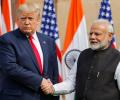
The China threat continues to resonate in the strategic partnership between India and the USA, points out Rup Narayan Das.

As India's stock rises, the resolution of the border row may become even more difficult, warn Harsh V Pant and Kalpit Mankikar.

India spent USD 63.9 billion on its military in 2017, an increase of 5.5 per cent compared with 2016 and of 45 per cent since 2008.

External Affairs Minister S Jaishankar on Tuesday said it was necessary to acknowledge that China will influence India's neighbouring countries, and India must not be scared of such "competitive politics".

The "bumper" 40 per cent increase followed a number of sweeping reforms intended to transform the "bloated People's Liberation Army, into a more modern, nimble fighting force".

Jaishankar said, "The immediate part which awaits us is what we call the de-escalation, which is the build-up of forces along the Line of Actual Control."

'When compared to many of America's treaty allies in Asia, Modi 3.0 is on a much stronger footing.'
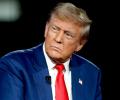
A leading expert predicts that the incoming Trump administration will likely continue its pro-India policies, including the Indo-Pacific strategy and Quad, but highlights potential challenges such as trade disagreements, immigration issues, and a possible quid pro quo for technology sharing. The expert also notes that the Trump 2.0 administration may prioritize great power politics over strategic altruism, potentially impacting human rights and religious freedom concerns.

There is a reason this 11 year phenomenon is a rule as much as it is an observation. It speaks to the nature of man and what humans are like, explains Aakar Patel.
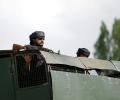
'Whatever we do, the purpose will be to re-establish deterrence.'

HAL, BEL and MDL feature on Sipri's list of the 100 largest arms producers in the world.
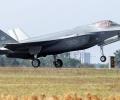
We need to equip the Indian Armed Forces, not 'commercial' as Trump wants, but 'operationally' looking at growing Chinese military capabilities, asserts Lieutenant General Prakash Katoch (retd).
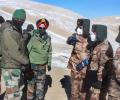
"China creeps towards hegemony in Asia, threatens India's borders, and treats other countries as junior partners, Indian-American Congressman Ro Khanna said.

'The United States should not, by this logic, expect India to create military distractions along the Line of Actual Control, hold up Chinese shipping in the Indian Ocean, or even openly provide intelligence or basing for US forces transiting the region.'
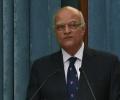
Former National Security Advisor (NSA) Shivshankar Menon has stated that the political dynamics between India and Pakistan have resulted in a "controlled level of hostility" that benefits the ruling elites in both nations. Speaking at the Kerala Literature Festival, Menon described Pakistan as a "brand new state" still grappling with its national identity. He argued that India's foreign policy towards Pakistan is influenced by its domestic politics, resulting in an uneasy equilibrium characterized by a "controlled level of hostility." Menon also questioned the concept of a multipolar world, stating that the current global order is merely "confused." He emphasized that the United States remains the world's true military hegemon, while other nations, including China, are regional powers. Menon further argued that there is no binding international order, leading to a state of "between orders." He highlighted the absence of definitive international agreements on crucial issues in recent decades.

After the denial of visa to the then Northern Army Commander Lt Gen B S Jaswal by China in 2010, New Delhi had frozen all bilateral defence exchanges with Beijing

'If the situation deteriorates and there is further escalation, the USA is in preparedness.'

It's a strategic approach in which the country's military and defence mechanisms evolve continuously in tandem with emerging threats. The new strategy anticipates events and prepares to counter those proactively.
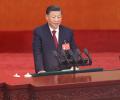
'No Cold War should be reignited and no Ukraine-style crisis should be repeated in Asia'
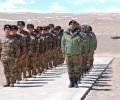
The Working Mechanism for Consultation and Coordination on India-China Border Affairs (WMCC) was established in 2012 as an institutional mechanism for consultation and coordination for the maintenance of peace and tranquillity in the border areas.
Chinese foreign ministry spokesperson Mao Ning told the media in Beijing on Monday that the two sides held an in-depth exchange of views on expediting the resolution of relevant issues.

'Three decades of intensive discussions, protocols and Confidence Building Measures were jettisoned one fine morning in 2020.' 'The primary lesson that has been learnt is that that there is no reliability about the Chinese.'

China represents the "largest threat" to Britain and the world's security and prosperity this century and there is evidence to suggest it has targeted countries from the US to India, UK prime ministerial candidate Rishi Sunak said on Monday.

Addressing party MPs at the general body meeting of the Congress Parliamentary Party in the central hall of Parliament, she said when facing a significant national challenge, it has been the tradition in our country to bring Parliament into confidence.
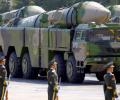
According to the experts, a lot of countries have little or no faith in Chinese companies because of poor after-sales support and equipment that rapidly declines into non-functional machinery.
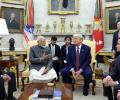
'By his words, actions, and body language during their joint press appearance wanted to convey his personal respect and, more broadly, his desire to work closely with India.'
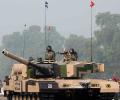
Senior Colonel Liu Degang said the Arjun tank is "very good" and suits Indian conditions.

The executive order, which was signed by Trump on Thursday, prohibits certain purchases involving publicly traded securities or any securities that are derivative of or are designed to provide investment exposure to such securities of any Communist Chinese military company.

'The first and most basic responsibility of any government is to protect its people from external threats and internal harm.' 'Budget 2025-2026 has to focus on meeting this responsibility,' asserts R Jagannathan.

Experts said the tensions have added to a sense of apprehension in the United States, Europe and parts of Asia that China will engage in more aggressive behaviour in pursuit of its territorial interests, which in turn has raised the possibility of a serious and coordinated pushback by leading global players.

'India's specific concerns about whether Russia will be a reliable defense supplier and diplomatic partner in the event of heightened hostilities with China has undoubtedly accelerated the process of US-India defense and intelligence cooperation intended to support Indian military positions along the Line of Actual Control.'
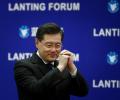
Qin, who is visiting New Delhi to attend the G20 Foreign Ministers meeting on Thursday, is expected to meet Jaishankar on its sidelines though the foreign ministry here is tight-lipped about it.
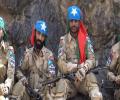
The Balochistan Liberation Army (BLA) has undergone a significant transformation, evolving from hit-and-run attacks to carrying out sophisticated operations with tactical precision. The group's tactics and targets have become increasingly audacious, targeting security forces, Chinese nationals, and innocent civilians. Experts attribute the BLA's evolution to various factors, including the leadership of Bashir Zeb, the group's growing intelligence network, and its exploitation of the grievances of the Baloch people. The BLA's actions are a cause for concern, as the group's sophisticated attacks pose a major challenge to security forces.
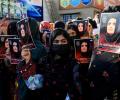
'When so many young Baloch men and women are willingly volunteering as fighters and even suicide bombers.'
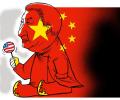
'Seen in the context of world turmoil in face of the pandemic and the Chinese 'miracle' of being the only country in the world to control it, this is not merely a 'Sputnik' moment, but a 'Sputnik Plus' moment,' argues Colonel Anil A Athale (retd).

Beijing will be intently watching Washington's response for any hint of weakness. Xi Jinping, who feels China has a limited window of strategic opportunity, will be emboldened to take additional initiatives in the Indo-Pacific and specifically against India and Taiwan, warns Jayadeva Ranade, the former senior RA&W officer and China expert.

This includes over $15 billion of proposed investment in the infrastructure sector in the Indo-Pacific and $9 billion for shoring up American defence in the region.

Although the Malabar is a routine exercise which has been carried out for several years now, security experts attach a lot of traction to it in view of China's assertive behaviour in the South China Sea, observes Rup Narayan Das.

'If you behave like a nail, the adversary will behave like a hammer.'
